
Five Barking Dogs

Blog

Follow the Yellow Brick Road!
Follow the Yellow Brick Road!

Follow the Yellow Brick Road!

This past weekend, my friend Polly Rothstein’s dog Darwin made his theatrical debut as “Toto” in a local
high school’s ambitious production of The Wizard of Oz. Darwin is a 20 month old Cairn Terrier, just slightly
larger but in all other ways identical to “Terry”, the Cairn used in the 1939 film. Getting Darwin
ready for the production has been the focus of Darwin’s training since he first got the invitation
to perform from the show’s wonderful “Dorothy”, talented Kayla Fuhst. Here’s a summary of
what we did to prepare him for the show.

Preparation.  A dog trainer friend called me a few months ago, looking for a dog to play “Toto”.  We’re introduced to Kayla and her family, and Darwin and Kayla hit it off immediately – so Darwin’s got the job! Darwin’s owner and I are thrilled at the prospect of his debut. We are provided with a list of
things that Darwin will need to be proficient with in his role as Toto. Surprisingly, our Toto will
not have to spend any time being carried in a basket, nor even ride on a bike -­ but he will need
to follow along in step with Dorothy et al as they make their way along their adventurous path.
My job was to prepare Darwin for this role so that the on­ and off­stage atmosphere would not
be stressful to him. We started this by inviting Kayla to visit Darwin in Polly’s home several times
before rehearsals begin. These first meetings were such fun for both, and key to our goal in
having a happy dog for the show.

First rehearsal. Polly and I make sure that Darwin is all set ­: pottied, water available (someone
backstage has already painted a custom water bowl for him with “Toto” written on it). Since the
costume designer has sewed an extra pocket on to Dorothy’s gingham dress for treats, it only
takes a few reps of “Walk with me” to convince Darwin that Dorothy is his new best friend. He
seems to take everything in stride:­ even the student orchestra playing close by, for which Polly and I had
prepared him by playing recordings of music and applause as we trained him at her home. As he trots
along with Dorothy to visit Professor Marvel in the first act, he sniffs each of the musicians’
heads while passing by. This, just as Dorothy says, “Oh, Toto, that’s not polite! We haven’t been
asked yet.” The fourth wall has been broken! We’re off to a great start.
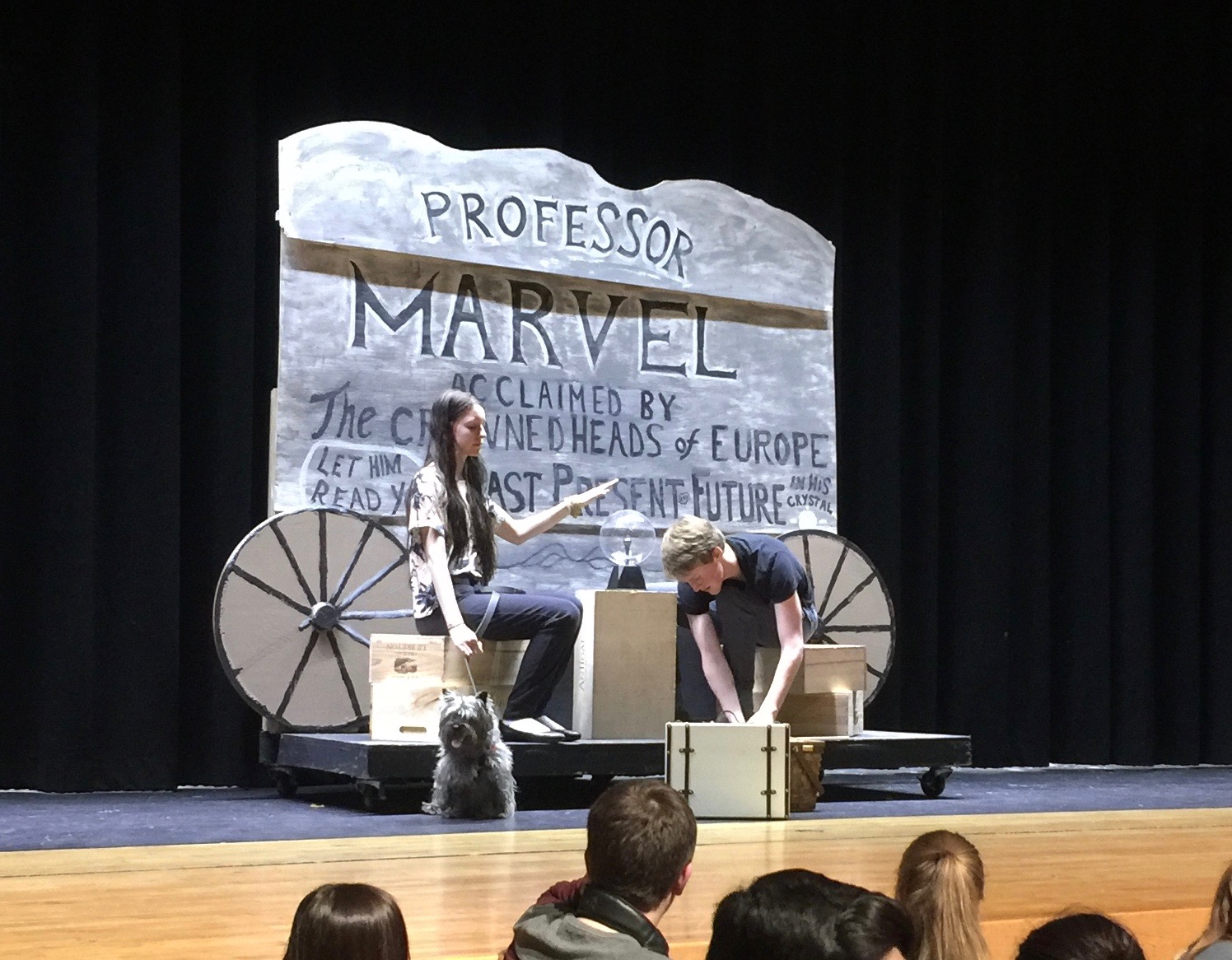
Rehearsal #1 with Kayla as Dorothy, “Toto”, and Professor Marvel.
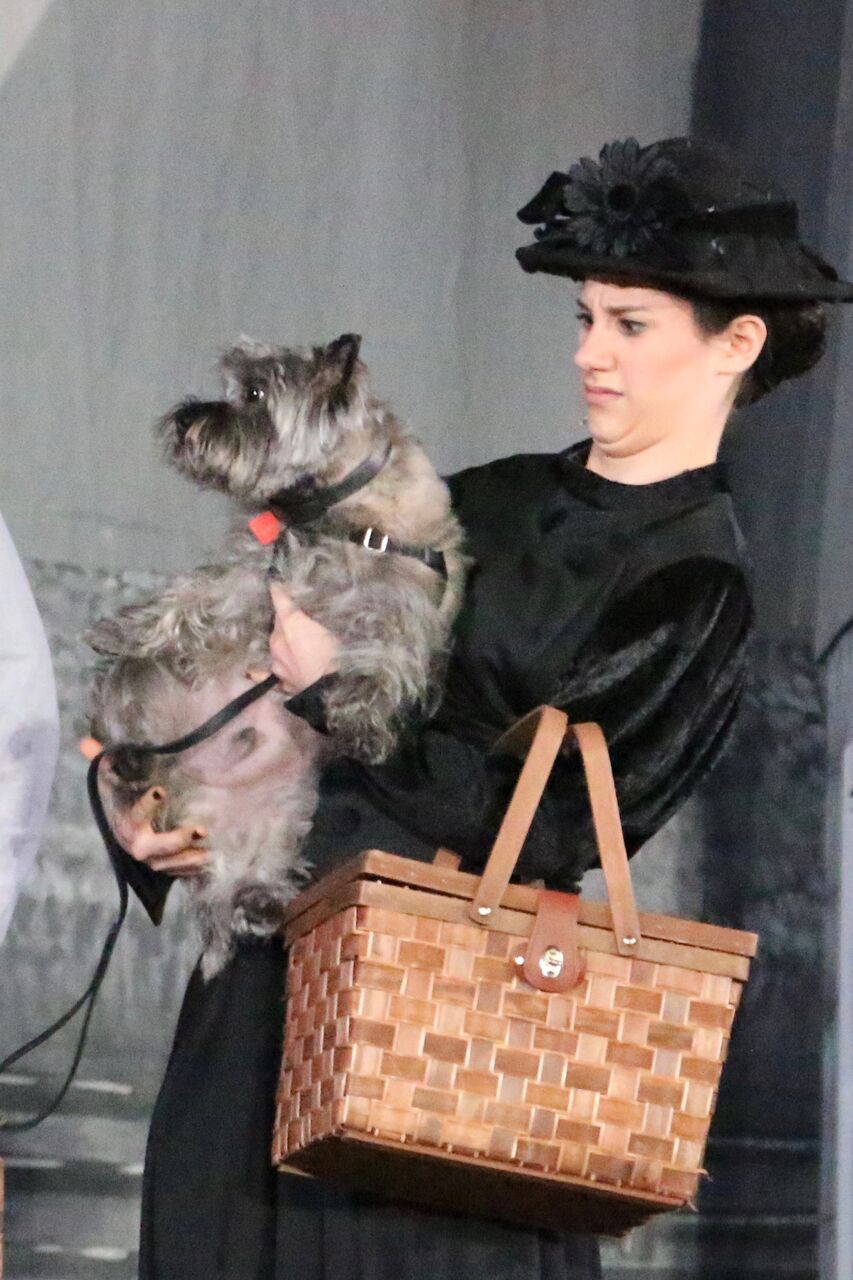
Miss Gulch and Toto. Photo : Chester Rothstein

Polly and I needed to prepare Darwin for a potentially frustrating scenario : being tethered to a
point on the set and left there while the cast performs a musical number. Many dogs restrained
in this way begin to pace, bounce, and bark ­- but Darwin settles into a patient Sit even though
his position is right next to the percussionist. Teaching him to “Go to Place” was an important facet of
Darwin’s training in his Skills class ­and he remembered that bit of his training even in this brand
new location.
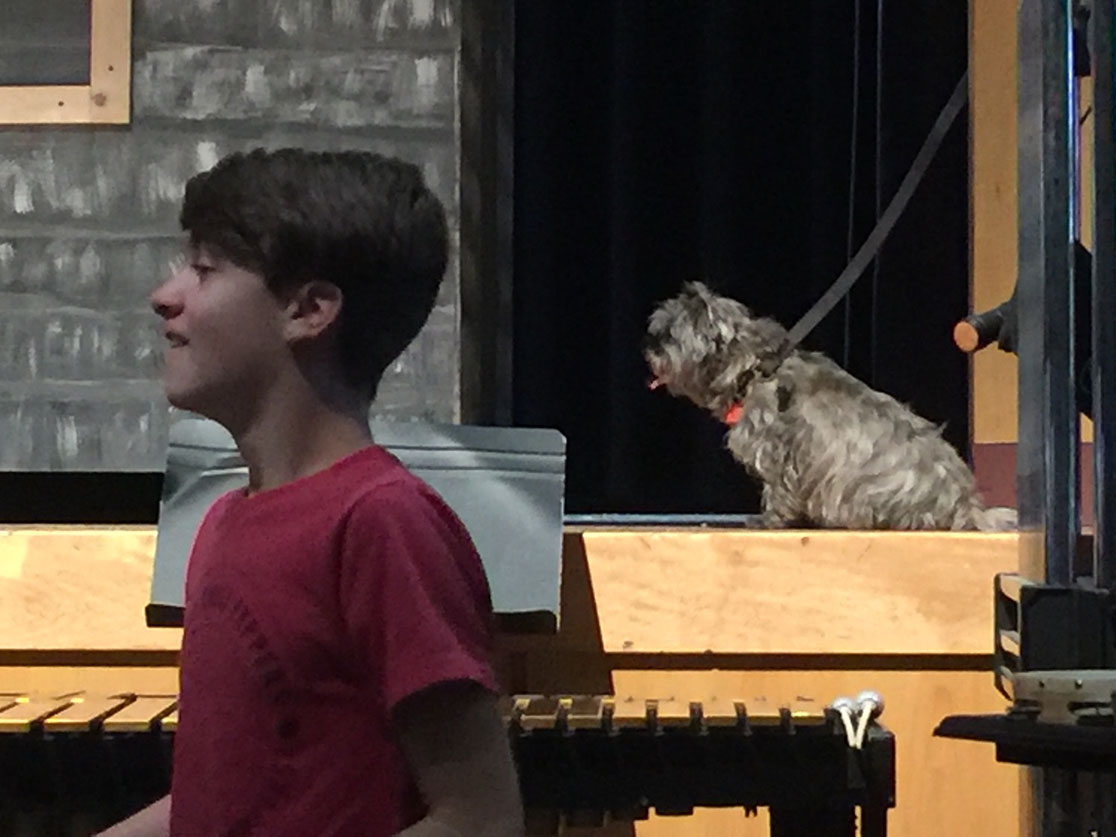
Tethered and waiting…good boy, Darwin!

The rehearsal stops and starts, and Darwin seems to be handling the whole thing very well ­until the Wicked Witch stomps suddenly around the corner of his fallen house, brandishing her
broom over her head and screeching “I’ll get you, my pretty!” This is too much for “Toto” and he
erupts at his adversary in a fit of alarm barks! Certainly this is method acting at its best, but the
cast and I agree that it’s probably not wise to startle “Toto” in this way, and from then on he’s
surreptitiously removed from the scene before the Witch begins her threatening rant.

Second rehearsal. I’m coaching not only Dorothy, but her friends the Scarecrow, the Tin Man,
and the Cowardly Lion that the rehearsals are the best time to show “Toto” that being onstage
with them, and being held by each of them from time to time, is very rewarding indeed. Each
actor gets treats to reward “Toto” for hanging out with them, and he even enjoys being whisked
away by a Flying Monkey! He has moments of worry and is given frequent breaks during these
first rehearsals, but readily comes back to work, ears and tail held high, with all of the members
of the cast ­- especially since they’re paying him so well!
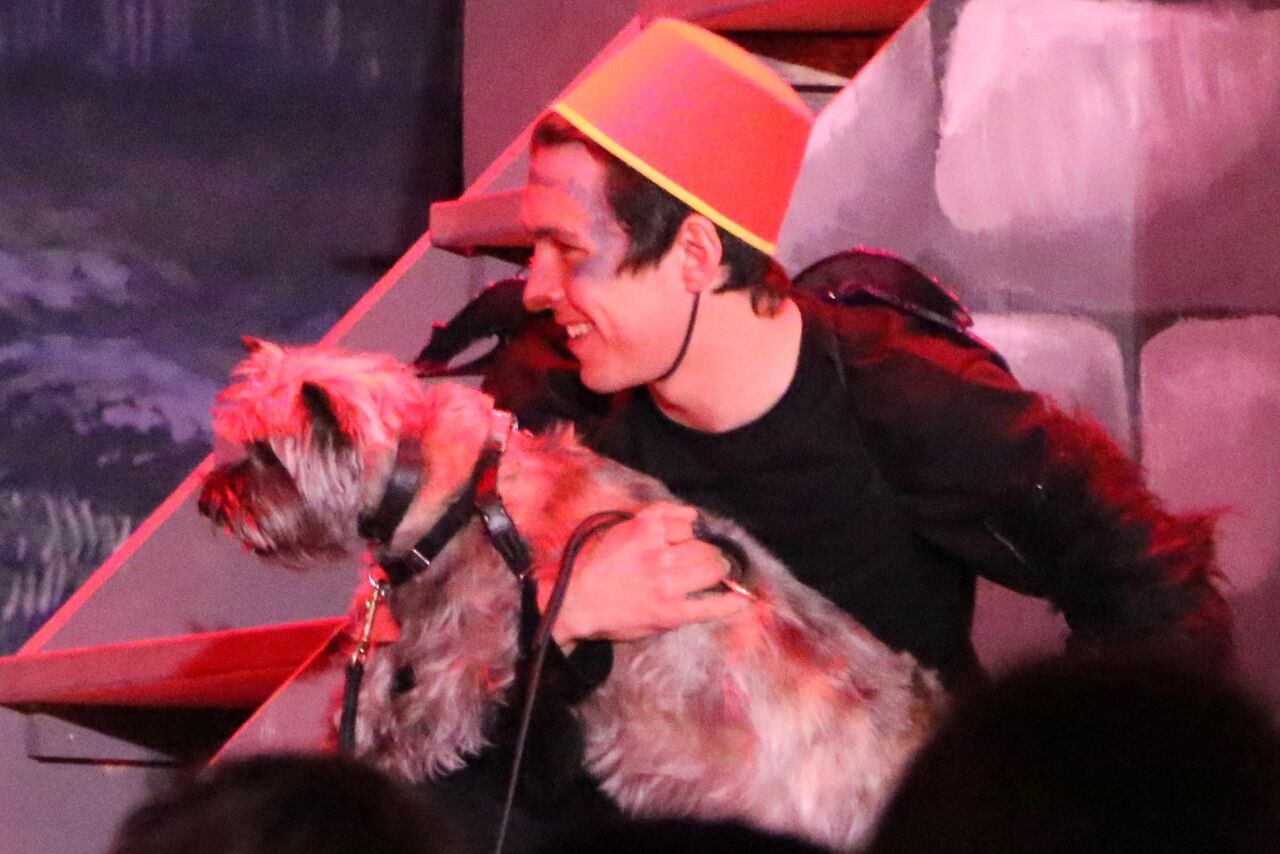
Toto and a Flying Monkey. Photo : Chester Rothstein

It’s such fun to see such talented actors put together what will clearly be a great production.
Even at this early stage, it’s clear the show is full of talent. Towards the end of the rehearsal, as
Dorothy prepares to leave Oz with the Wizard, she begins to say  farewell to each of her new friends.
The actor playing the Tin Man starts to give Dorothy a hug goodbye during this last scene, and
then freezes! The director booms to him from the auditorium: ­ “WHAT’S the PROBLEM ­- she’s
leaving forever – you need to  ­ HUG HER!” Without breaking character, the poor Tin Man cries, “I can’t. My
hands smell like dog treats!”
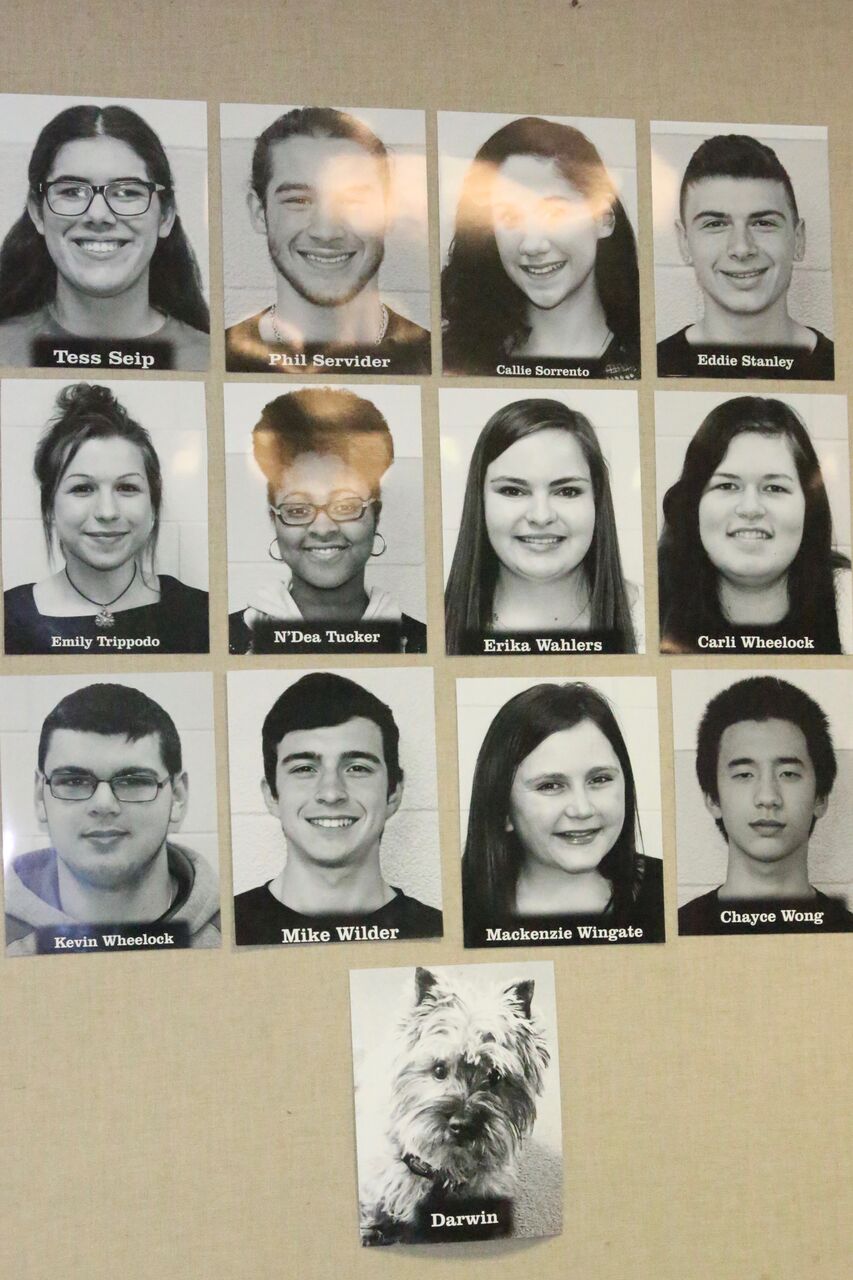

Cast headshots in the auditorium lobby. Photo : Chester Rothstein

A reporter stops by the school for the final dress rehearsal, takes plenty of pictures of
Toto and the cast, and we see them appear on the paper’s website the next day.
“Toto
is played by a perky little pooch named Darwin.” reads the caption.
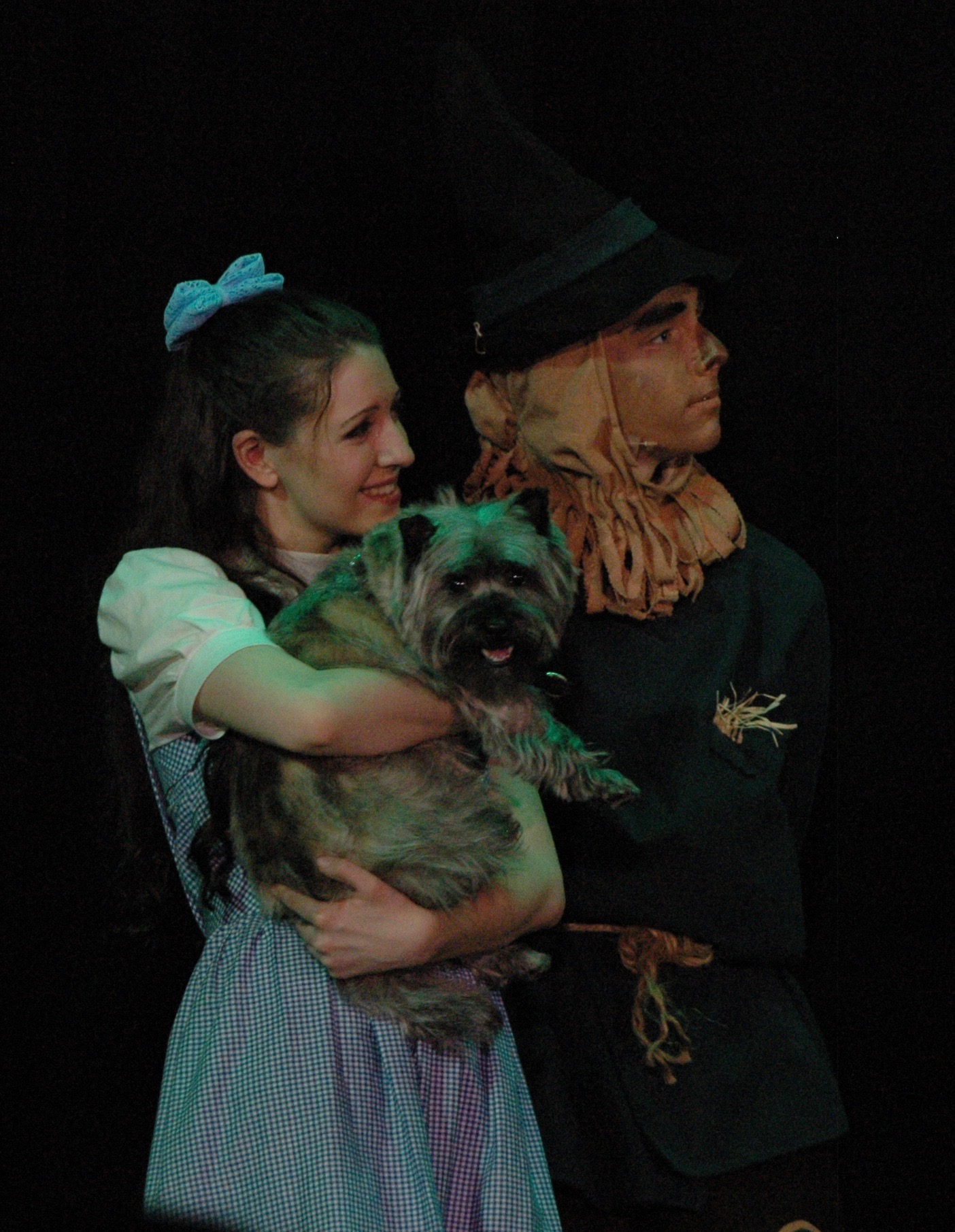
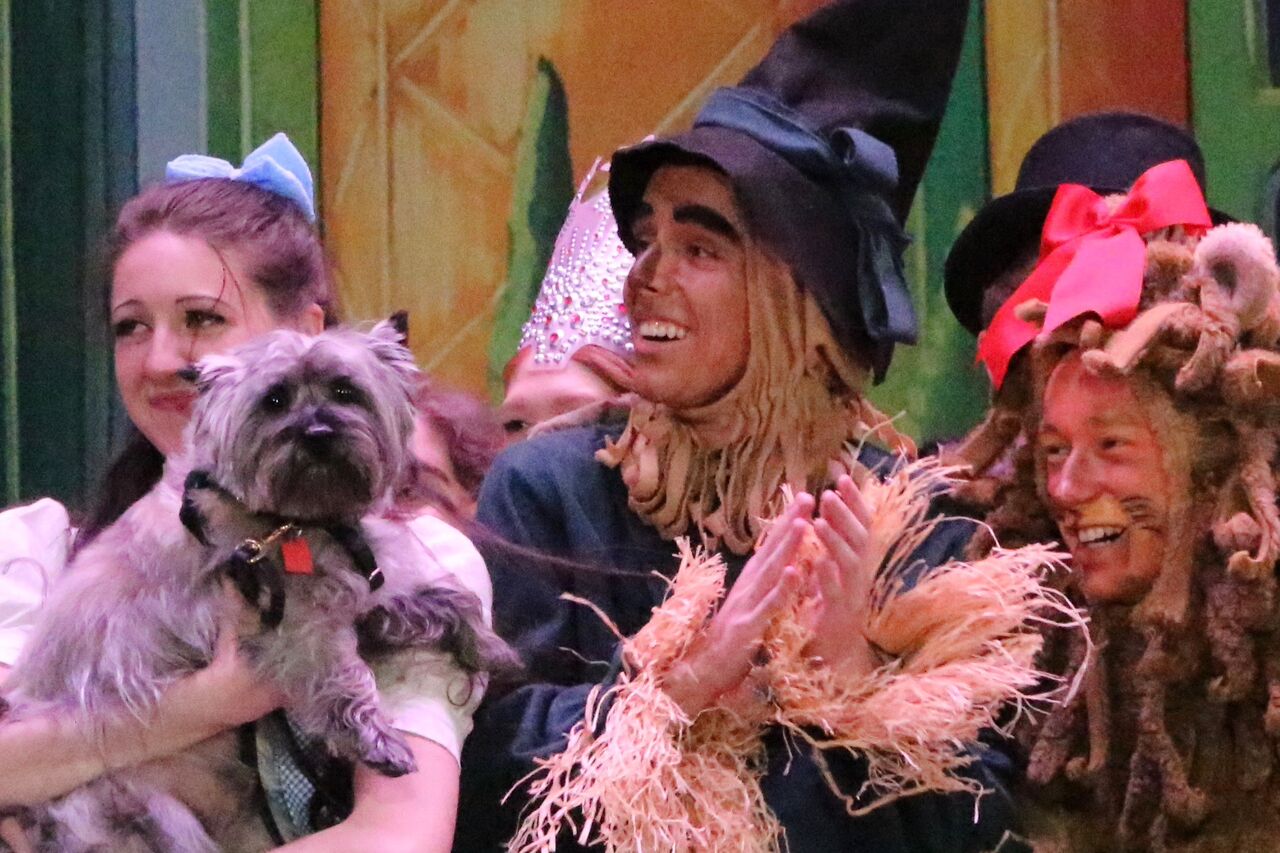
Darwin as “Toto” with Dorothy and the Scarecrow

Opening night. I have taken care to sit in a seat where Toto can’t see me from the stage.
Though he’s been confident throughout the rehearsals, we’ve noticed that he will try to leave
Dorothy to come to find me. I’m flattered by this but don’t want to add more stress to Toto’s
experience ­- there’s quite enough happening already, what with the cyclone, the unruly mob of
Munchkins, the heat and noise of the stage, and the electric atmosphere of the show. The
audience reaction during his first appearance is huge, but once again, he isn’t stressed by all of
the applause and appreciation as he steps on to the stage like a champion.


Darwin has been raised since puppyhood with nothing but positive experiences with new
people and “strange” places and activities. He is a bold dog, with an outgoing personality and
isn’t easily startled or scared by dancing Poppies, marching Winkies, or screeching Witches
(though this last was certainly where the line was drawn). A timid dog who was easily worried
by the bangs, crashes, and unexpected pratfalls of Scarecrows would have been miserable in
this role. Darwin was perfectly happy throughout all 4 performances because he’s a confident
dog, well socialized with people and always happy to be part of the fun. It’s wonderful to see
him enjoy being part of the show, and to see the audience clap wildly for him in the final curtain
call.
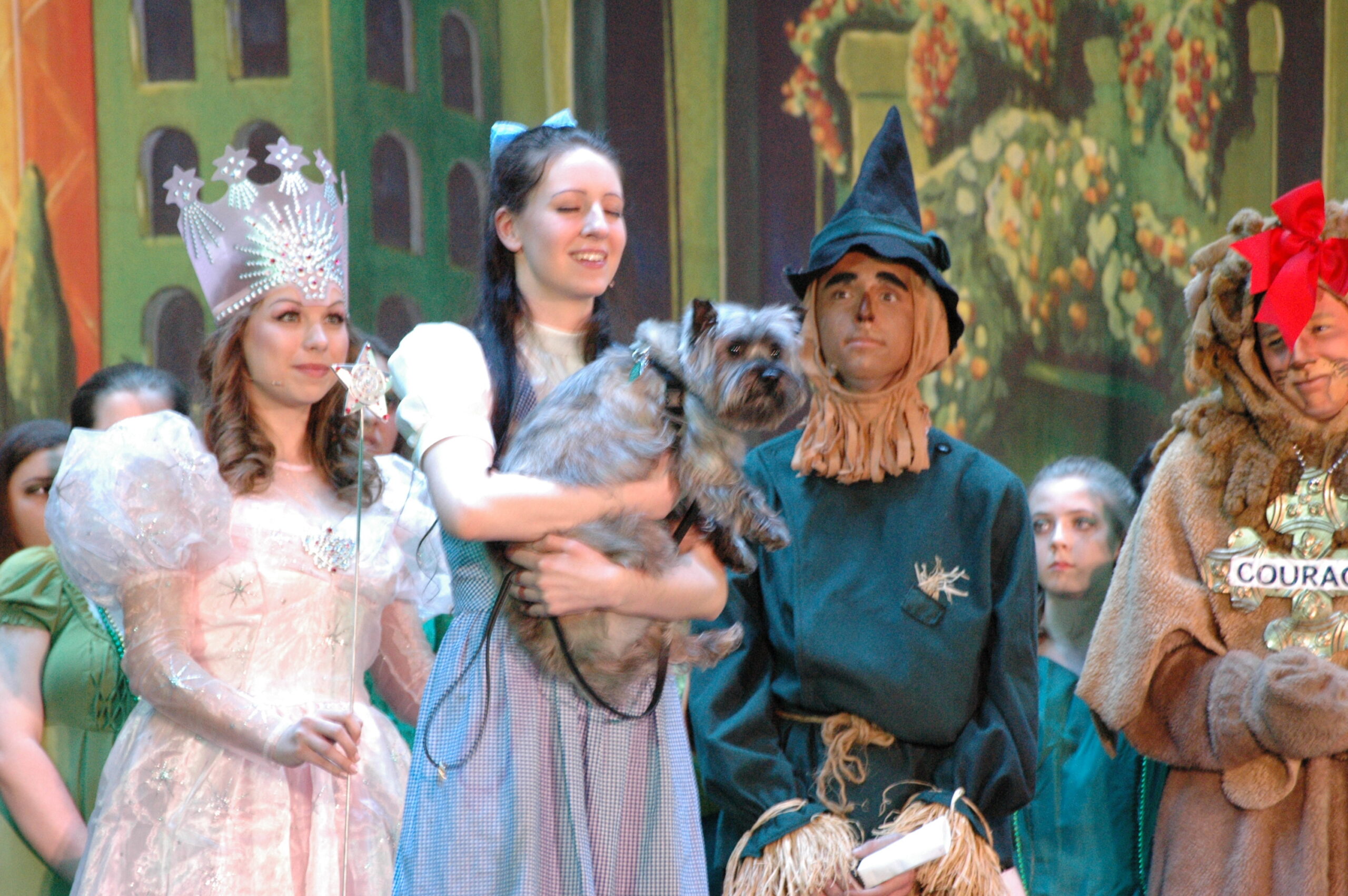
“Toto, too!” Glinda, Dorothy, Toto, the Scarecrow and the Lion

I’ve been working with Darwin and his owner Polly for over a year. In that time, Polly’s laid a great foundation for him with the training classes she’s taken as well as private tutoring. It is
especially nice to see that Polly, who is disabled and must use a walker, never let that slow her
training down. “
My Physical Therapist and I both think dog training is a good thing to do. Anything to widen horizons or give
people a new thing to master.”
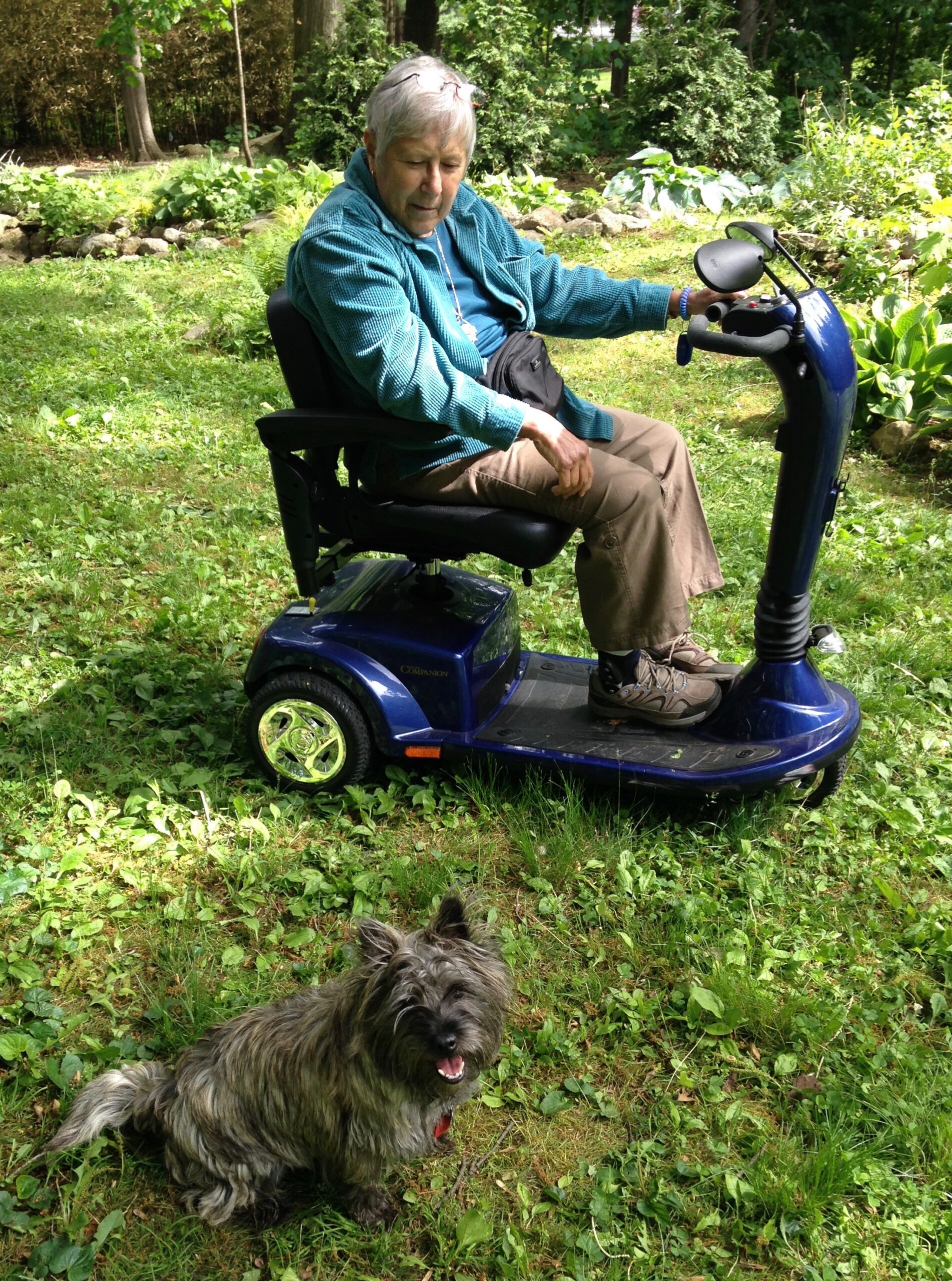
Polly with Darwin


Training essentials for Darwin

  1. Socialization. Not merely exposure to novel people, places, sounds and things when a pup, but positive experiences and obvious and overt enjoyment of the whole process.
  2. Making good friends first with Dorothy and then the rest of the cast. We were so fortunate that our “Dorothy”, Kayla, is a true dog lover who understands positive reinforcement training.
  3. Good pottying habits! I know, this is pretty mundane, but a nightmare if this particular aspect of a dog’s education isn’t airtight.
  4. Trainability – any dog ready for the stage enjoys learning, can work through frustration, and has great impulse control.
Misa Martin is a Certified Professional Dog Trainer. Years of attending agility seminars, workshops, seminars and camps with her first dog led to the beginning of her professional dog training career as a PetSmart Trainer in 2008. In addition to joining Port Chester Obedience Training Club’s Family Manners program, Misa is a staff trainer at the Mount Vernon Humane Society, active with Pets Alive Westchester as a group class instructor and consultant for training and behavior issues, and a volunteer for the Walden Humane Society’s education program. Misa owns Hudson Valley Dog Trainer, providing reward-based training to private clients. Through her knowledge, experience, and sense of humor, Misa encourages students to approach dog training as a team effort, where students learn as much from their dogs as dogs learn from their “parents,” making training fun for humans and dogs alike! Misa can be reached at [email protected]

SaveSave SaveSave

Attending a Dog Seminar

Attending a Dog Seminar

Attending a Dog Seminar


Attending Dog Training Seminars, Workshops, and Camps

I’ve been an enthusiastic attendee of (mostly) Agility seminars since 2003. As a member of the CCPDT, I also attend the dog trainers’ version of professional development seminars.  I wanted to share with you some tips for getting the most out of these fabulous opportunities for learning.

IMG_3730.jpg

Agility run-throughs at Port Chester Obedience in White Plains, NY

What kind of seminar is it?

Dog behavior and training seminars abound here in the Northeast.  Professional trainers, hobby trainers and animal lovers who have an interest in training all look forward to events such as the APDT Conference happening annually, and can also attend webinars and specialized lectures which are a key component of advancing our learning in what is fundamentally a science-based profession.  Trainers certified by the International Association of Animal Behavior Consultants (IAABC), the Certification Council for Professional Dog Trainers (CPDT) and the Association of Professional Dog Trainers (APDT) need to get CEUs to keep their certification, and most of us wouldn’t miss a chance to hear about the latest advances in training and behavior from the likes of Karen Pryor, Ken Ramirez, Kathy Sdao, and Steve White, and so many others!  


coppingerfriedman.jpg

Raymond Coppinger and Susan Friedman – featured speakers on a panel at the APDT conference (Photo courtesy Dorotea Rivera)

Tip #1 : If you’re thinking about attending a lecture or seminar such as these, check to see whether dogs are allowed in the space you’re headed to.  If you’re planning to go to a larger event where dogs are welcome such as ClickerExpo, there’s a ton of great info about what to expect on their site.  

Attending Agility classes and run-throughs at your local club or training center is a great  step in your training in this exciting sport. One important facet of your dog’s education is going to be learning how to take her new skills on the road and play with you in new environments!  Seminars provide the opportunity to gain fresh perspective, challenge your comfort levels, and think outside of the box in a supportive atmosphere. In addition to that, it’s fun to get to know your fellow dog addicts agility enthusiasts at these events –  my participation in the sport of Agility is especially enhanced by being part of this fun community.


IMG_5986.JPG

“My turn!” Flop and I getting ready to run at a handling seminar, summer 2013.

Most Agility instructors and clubs will let you know when a special workshop is coming up (check those bulletin boards!).  An Agility seminar presenter will make the content of what they’re teaching available so that you can determine if it’s the right level for you and your dog. As an example, I just got an announcement for an upcoming seminar in my area. From the description : “Advanced/Masters or by permission. Dog should be able to do courses of jumps and tunnels – we will not be looking at weaves or contacts,” this is not a workshop for puppies or even my Novice-level dog.

IMG_3438.JPG

Puppy Camp! Puppy Lilu and Nelci and fun on an elevated plank

“Novice” or “Starters” level dogs have seen some sequencing in their regular training class and have been introduced to all of the Agility equipment, though they might not yet be “perfect”. “Open / Advanced means “Intermediate” level (and yes, this is worth an email to determine if your dog is ready for this level!) Advanced, Masters and International level seminars are for those teams who are already competing and/or have a thorough familiarity with Agility obstacles and handling.

IMG_1970.jpg

My puppy wasn’t ready for the handling moves in this seminar, so I audited and practiced focus, attention, and play with her on the sidelines.

   Neno Pessoa runs IQ Agility in Bloomsbury, NJ and enjoys hosting and teaching Agility seminars at his great facility and elsewhere. “My favorite thing about teaching is to see the people’s faces as they are walking the course wondering how they can possibly do it!   Then, when they learn how to handle it by the end of the seminar.”  How can attendees make the most of the event they attend?  “People who go to a seminar to socialize or who refuse to try or learn anything new or different from what they think they or their dog can do can’t get much from seminars,” says Pessoa.  Seminar presenters will help you through the learning stages of new-to-you techniques, most often by breaking that new behavior or handling move into small, digestible steps.

I met Monique Plinck at a seminar that she taught this past summer at Port Chester Obedience Club. Her Criterion Agility facility is located in Middlefield, CT. Though it was apparent during her days at PCOTC, her great joy in teaching seminars “…is working with handlers I don’t regularly train with. Watching them settle in, grasp, learn and grow.” she says. That concentrated time has its’ limits, though : “Depending on the seminar time….4 hours, 1 day, 2 or 3 days – that limited time is a challenge with how much I want to cover and share while not overwhelming the group with content.”

IMG_5983.jpg

Seminar presenter Tracy Sklenar explains a jump sequence as handlers and dogs get warmed up

More Agility Seminar Tips:

#1. Prepare! Pack a comfortable, portable chair and bring a notebook. Make sure your dog’s treats are prepared and your toy bag is packed!

#2. Is your dog comfortable in his crate? Practice this at home well before you go. You will get so much more out of your seminar if your dog can settle in a crate. Walking courses while your dog is upset and stressed in his crate makes it harder to learn and get the most out of your time at your seminar.

#3. Charge your cell / camera batteries and ask your neighbor to film your dog’s runs. Chances are they will ask you to do the same!

#4. Read the fine print! The guidelines that will be emailed to you should be detailed re: directions to the site, local hotel information if need be, and particulars about the site. (Examples : Some locations have plenty of room for both working and non-working dogs, and some do not. Another example : Lunch arrangements are handled differently at every seminar I go to.)


Have fun! Learn something new with your dog! What seminars have you attended lately?

__


Misa Martin is a Certified Professional Dog Trainer. Years of attending agility seminars, workshops, seminars and camps with her first dog led to the beginning of her professional dog training career as a PetSmart Trainer in 2008. In addition to joining Port Chester Obedience Training Club’s Family Manners program, Misa is a staff trainer at the Mount Vernon Humane Society, active with Pets Alive Westchester as a group class instructor and consultant for training and behavior issues, and a volunteer for the Walden Humane Society’s education program. Misa owns Hudson Valley Dog Trainer, providing reward-based training to private clients. Through her knowledge, experience, and sense of humor, Misa encourages students to approach dog training as a team effort, where students learn as much from their dogs as dogs learn from their “parents,” making training fun for humans and dogs alike! Misa can be reached at [email protected]

Adopting an Adult Dog from a Shelter

Adopting an Adult Dog from a Shelter

Adopting an Adult Dog from a Shelter


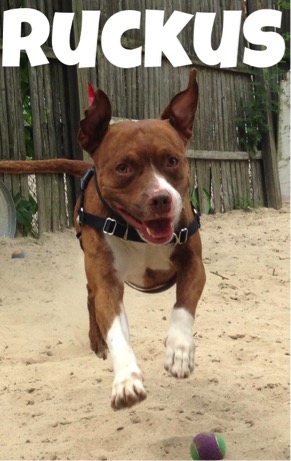
 “Ruckus” at the shelter – stay tuned, more about him at the end of this article! 
Adopting an Adult Dog from a Shelter
I work as a dog trainer for an open-intake city-run shelter in an urban area several days a week. We are on the front lines there, and often get calls about dogs in situations that are less than ideal. And yet, once those dogs have had a chance to get the care they need and a behavioral evaluation (done by myself and my co-trainer) these dogs are ready and especially deserving to get adopted. Many of the dogs we meet are elderly, which is heartbreaking to see as it’s clear that they’ve known some version of a home. These dogs are especially close to my heart. If you are considering opening your home and your heart to one of these very deserving dogs, here are some tips.
 Damu, who never met a stranger! Adopted from the Mt Vernon Animal Shelter. 
    New-to-you dogs likely don’t know the rules of your home.

   I won’t assume that a dog of any age is going to be familiar with any basic rules: where to potty, what to chew on, and how to play and interact with their humans. Adopting a senior dog might involve setting up your home as you would for a puppy – limiting their space they have access to and keeping in mind that the gentle approach is best, as it’s possible that no one ever taught them basic house manners. My suggestions on this subject as a trainer center around the theme of not being “the bad guy” but rather using baby gates, crates, etc to manage where the dog can go, and limit the potential for accidents during the first few weeks. I couldn’t expect the shelter I adopted from to know whether or not the dog I’m taking home will already be potty-trained, especially in a new environment. The shelter environment and their housing can’t always give a clear indication as to whether the dog is house trained. Same goes for other rules – your new Senior adoptee may not understand that they might not be allowed on the furniture. No matter what the behavior, there is a gentle and kind way to teach it without resorting to yelling and frustration.
 

Freedom Ride: Mac on his way to the “Funny Farm”, a special home for Senior dogs in need. 

 Behavior issues 
 When one of our Senior Citizen dogs goes home, (after we’re done celebrating!), we offer phone and email support to the adopter for any questions they might have. This is the time period to expect insights into the past life of your dog.  Link, a Lab mix who lived briefly at my shelter, demonstrated an astonishing understanding of a long-distance Sit/Stay (better than my own dogs!) and continued to “Wow!” his adopters for months after he went home.  Sadly, once a dog has left the shelter environment, there can also be signs of lack of understanding of normal household activities and even signs of maltreatment. One memorable phone call from an adopter revealed that her dog panicked and retreated to a corner whenever she picked up a Swiffer mop. In these very sad cases, ask the shelter you’ve adopted the dog from for help. Remember, a dog with fear issues such as I’ve described above needs humane training methods to get through these issues. 
 Hospice candidate Champ gets T-Touch therapy
 What a training class covers, and what it might not cover 
 Basic manners and obedience classes at your local training club might be very helpful for you and your Senior adoptee. Finding a trainer that uses humane methods is easy! That trainer will be able to determine an appropriate class for your dog, or if your dog might be happier with in-home lessons. It’s likely that your adult dog will be happy to show you what they’ve already learned, though his interpretation of your hand signals and verbal cues may not be exactly what you expect. (Did you know that there are at least 4 different ways to ask a dog to Sit?)
Your dog’s understanding of the “Drop it!” cue may also need a bit of refreshing – another behavior that I want my new dog to be very happy to do for me. Refreshing the basics with your new adoptee can only help – additionally, if your local training club offers classes in Nosework you may discover a whole new world of fun activities for your dog!
Your group class may not be able to cover topics such as Separation Anxiety or significant fear issues that your new dog might have. Fearful dogs may not enjoy a group class at all and might become worse! I don’t know of one instructor that couldn’t take a few minutes to answer questions about whether their class would be suitable for you and your dog. A referral to a positive trainer ought to be able to assist you in finding help for these issues.

When it’s time to ask your shelter for help

I have worked for shelters that have offered “Forever Foster” programs for dogs, which has been ideal for Senior dogs and their owners. Many larger shelters are able to offer free medical care for the lifetime of the dog, and some even offer free food – from the shelter’s point of view, this is absolutely worth it if the dog can go to a real home.
Your shelter might have training notes and notes that the shelter trainer has made for your dog. Keep these handy! You might want to refer to them when going over a management and training plan with a trainer.
Some shelters might be able to offer low-cost boarding for your adopted dog, and some will need to refer you. It’s important to consider how being back at the shelter, even for a short time, might affect your dog. Shelter staff will likely be able to provide insight about how well / how happy your dog was while he lived there. 

 
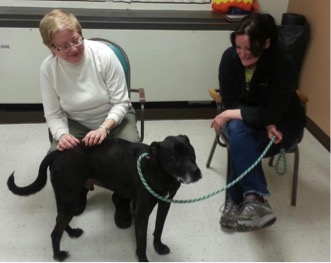
Training at the shelter (photo credit : Ann King)
In closing, I thought you‘d enjoy reading a letter from an adopter about her Augie, a beloved shelter dog who went to his fantastic forever home in September of 2014.
 Why an adult dog? Puppies are cute but they are a huge undertaking. I knew I didn’t have the resources or lifestyle to accommodate overnight feedings, potty training, and puppy proofing my home from destructive chewing.

My dog came to me extremely house broken. He would hold it for up to 20 hours because he didn’t want to mess up his kennel at the shelter. He would be the first to be let out by a volunteer in the wee hours of the morning. As an RN, who has also had to “hold it” for many, many hours (hence the term nurse’s bladder), this broke my heart.

With adult dogs, you know what you’re going to get. For the most part, you know what kind of temperament and personality they have. The trainers will evaluate if the dogs are good with other dogs, kids, etc. When I walked my dog as a volunteer, I noticed he was not a barker, he was affectionate, and shy. He is still pretty much who he was, although more playful.

Augie also came to me knowing several commands. I did enroll him in obedience school but it was really because I needed the training! Adult dogs may already be trained or receive training at the shelter and know how to behave in a home setting. They settle in and get the routine quickly, provided you maintain one.

Adult dogs are very special as you get to give them their second chance. I see the love and devotion in Augie’s eyes and I have no regrets about my choice. He has rescued me from myself many times over.

People say I spoil him but it’s entirely untrue. He absolutely deserves everything I give him. I don’t know what the first 3 years of his life were like but I am determined to make the rest of his years wonderful. – S. Choi, January 2016


 Ruckus, now Augie at home, December 2015


Misa Martin is a Certified Professional Dog Trainer. Years of attending agility seminars, workshops, seminars and camps with her first dog led to the beginning of her professional dog training career as a PetSmart Trainer in 2008. In addition to joining Port Chester Obedience Training Club’s Family Manners program, Misa is a staff trainer at the Mount Vernon Humane Society, active with Pets Alive Westchester as a group class instructor and consultant for training and behavior issues, and a volunteer for the Walden Humane Society’s education program. Misa owns Hudson Valley Dog Trainer, providing reward-based training to private clients. Through her knowledge, experience, and sense of humor, Misa encourages students to approach dog training as a team effort, where students learn as much from their dogs as dogs learn from their “parents,” making training fun for humans and dogs alike! Misa can be reached at [email protected]

Fearful Dogs and Agility

Fearful Dogs and Agility

Fearful Dogs and Agility


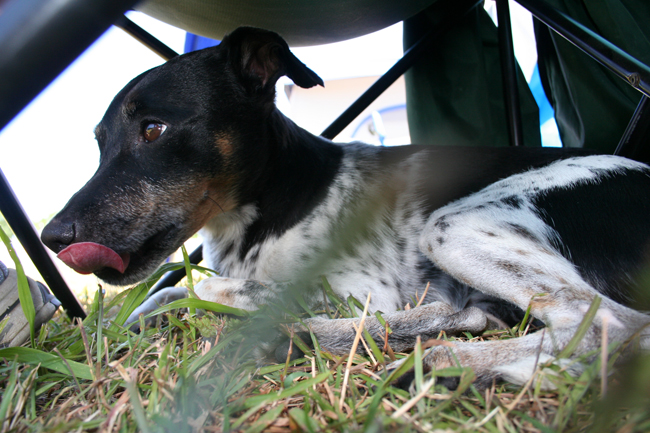
“No thanks, I’m good here.” Flop under my chair at an Agility trial in 2003.

About motivating shy or shut down dogs.


If your dog needs a job to do, get to an Agility class! A bold, confident dog with high energy levels is the obvious candidate for Agility. But what about shy dogs who could use a boost in confidence? When approached the right way, Agility is a great activity to bring out that inner rock star in your partner!

My oldest dog, Flop, was nervous at times in new places. He is sound sensitive, and was very worried about “whoops!” mistakes that I made (and for good reason : when he was a pup, I attempted to train him as I carried a purse, thwacking him in the head several times with it as we practiced Loose Leash Walking. To this day, he flinches at sudden movements towards his head. Stupid me.) I wish I had caught on sooner to Flop’s obvious dislike of my carelessness, and I wish I’d known more about how dogs look when they need to take a break – whether from training OR from being in an environment that they’re worried about. (For detailed info about dog body language, I’ve linked some calming signal guides below to get you started.) This great info would have been of much help when I was starting out.

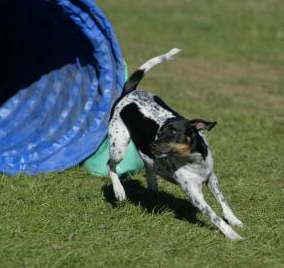
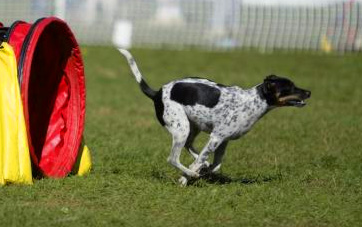
Tunnel fun! Flop competing, spring 2005

Where to begin when you see your dog worrying about new environments? The first rule is to teach your dog some basics in a place where he’s confident. For both dog and handler, learning foundation behaviors in a safe, familiar place is always a good idea – you can take it on the road later, when you’re proficient at these.

“But what should I teach?” For starters, I strongly recommend teaching a “nose touch” / “hand targeting” behavior. This simple behavior will be a big help in getting your dog’s confidence up a purposely simple game that is easy to learn (your dog will love it because they will easily!) – it’s easy to throw in a very short practice session any time you think of it. Also, playing games and doing tricks that a dog is familiar with and have gotten a ton of reinforcement for is a favorite strategy for many trainers. The Spin and Weave through my legs behaviors are easily taught using a lure – so your dog will catch on quickly! – and the end product involves motion and dynamic movement with you.

Tricks and simple behaviors such as the hand target are often referred to as relationship building games. Agility instructor Tracy Sklenar of Agility U is known for her skills in motivating dogs and their humans and teaches handlers to build their relationship with their dogs in fun and creative ways. She says: “Simple, fun behaviors that get the dog moving are key – especially if you are using food as a reward. This is a “must” whenever you train – whether at the warm-up jump of a trial or in your living room!”

If your dog is sound sensitive, being close to the BANG! of a teeter or the action of a wobble board may be too much. Is your dog hunching down, tucking her tail and blinking when other dogs in class are practicing with these things? Move away far enough from the practice area so that your dog isn’t fearful of the noise – and use each BANG! as a Click! for your dog, and reward. This technique works very nicely with the structure of BAT training – specifically, the “Look at That” game and the “Engage / Disengage” game. Slowly decrease your distance when your dog is ready (remember those Canine Calming Signals? Look for those carefully to gauge your dog’s comfort level!) Never force or compel your dog to move closer to things that are worrisome – this is a surefire way to convince your pup that he should in fact be cautious about the object that you’re trying to pull him towards.

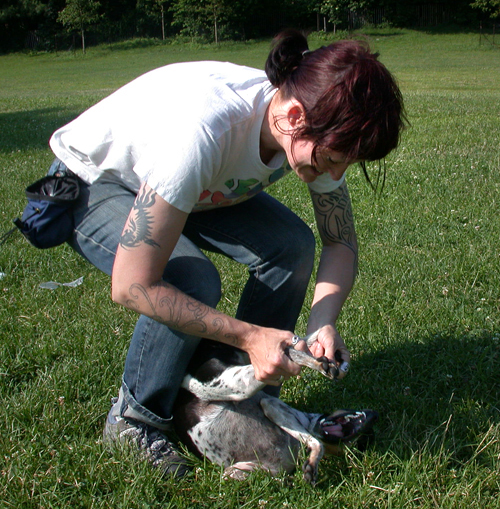
Believe it or not…Flop would flip into a somersault against my legs and I’d push him around on his back in the grass. We did this at many start lines at trials, to the astonishment of the ring crew and judge. This is how I knew he was really feeling good before a run.

Have you got a repertoire of behaviors that you can ask your dog to do that your dog clearly enjoys? Practice these often. You’ll see that the effect of engaging your dog in this way will boost his confidence.

With every dog in agility, we need to get the optimal state of arousal before a run in training or trialing. This involves play and moving! I like to ask for a simple, fun behavior (like a hand touch or a trick or a bark) then run a few steps and reward. The reward must be something that the dog truly enjoys, so choose wisely!

And if the dog is really struggling to deal with the environment, the handler must step back from trying to train agility and focus on getting the dog happy to play in new environments! – Tracy Sklenar

In new places, I’d only ask Flop for behaviors that I was confident that he could do. If asking for a sit was too much for him, then I’d just say, “yes!” and reward for eye contact or hand targeting and – more importantly – moving around with me. At home, I’d practice this and then end a short training session with another learned REALLY FUN behavior : “Let’s go get the cookies!” and a dash together over to the other end of the room for a big handful of treats. For many dogs, moving around while training is very helpful in reducing stress. Tracy reminded me more than once that I should not always be asking Flop to do doggie calculus but to concentrate on the fun, familiar games that helped his confidence to grow.

I tried to not get frantic or emotional about Flop’s stressy behavior in classes or at agility trials. This was hard, as the perceived “peer pressure” I was feeling in those places often compelled me to feel rushed, and that spilled over into me asking my dog for too many things. One thing at a time, especially for a new pup. Remember that our body language and demeanor are so much more important than what’s coming out of our mouths! Something to be mindful of as we show our partners that Agility is the best fun we can have with our dogs.

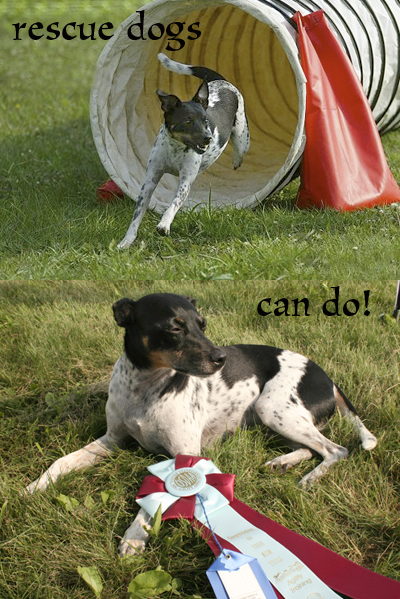
Champion dog Flop, summer 2005: fear of Agility trials firmly in the rear-view mirror.

There are a lot of resources to look at on the topic of dog signals and body language. Here are a few:

https://paws4udogs.wordpress.com/category/behavior…

and

http://www.quickanddirtytips.com/pets/dog-behavior…

as well as


The Canine Campus featured Canine Calming Signals in their January 2008 podcast.


Misa Martin is a Certified Professional Dog Trainer. Years of attending agility seminars, workshops, seminars and camps with her first dog led to the beginning of her professional dog training career as a PetSmart Trainer in 2008. In addition to joining Port Chester Obedience Training Club’s Family Manners program, Misa is a staff trainer at the Mount Vernon Humane Society, active with Pets Alive Westchester as a group class instructor and consultant for training and behavior issues, and a volunteer for the Walden Humane Society’s education program. Misa owns Hudson Valley Dog Trainer, providing reward-based training to private clients. Through her knowledge, experience, and sense of humor, Misa encourages students to approach dog training as a team effort, where students learn as much from their dogs as dogs learn from their “parents,” making training fun for humans and dogs alike! Misa can be reached at [email protected]

Things Your Dog Trainer Says

Things Your Dog Trainer Says

Things Your Dog Trainer Says

I wouldn’t have chewed your shoe if you had puppy proofed this house. Management, management, management!

I love seeing the looks of recognition and relief that come over my students faces as they recognize kindred spirits in their first puppy classes. Students see that their own puppy’s Ahem! moments are generally right in step with the other dogs – the sudden deafness, the ignoring of the Mama in favor of a fascinating smell, and oh my, the jumping up. Or barking. Or pawing us for attention. We trainers have heard plenty of wild puppy stories, and we have a lot of games up our sleeve to help. Not surprisingly, there are some common threads in the recommendations that my colleagues and I re-visit when it comes to helping students.

First on the list from every trainer I interviewed can be summed up by Bobbie Bhambree of DogCentric training, who says, “The one thing I’ve been saying the most is set your dog up for success by managing the environment.”

Got a new pup that’s a bit unclear about potty training? Manage this by confining your new dog to a limited area in your home where they are least likely to get into trouble. That’s a great beginning – and as your own trainer might remind you, combining management with proactive training will help your pup learn at a brisk pace.
As you practice exercises at home, you and your dog will likely start training in places where it is easy to perform a sit, down, or stay. That place will probably not be out on the street at first – too many un-manageable distractions for beginners. So we also manage our dogs learning environments as best we can.
Management is important for good manners in your home, says trainer Jenn Michaelis of Sassy T Canine Academy . Especially for things like counter surfing, chewing and jumping. Don’t work harder, work smarter.” She reminds her students that a well managed home environment will help in training as our pups are learning all the time!
Consistency from humans was second on the list from trainers I polled. In training classes, we encourage our students to use the same cues consistently for the behaviors we teach. A good example of this would be saying, “Down” only when we want our dogs to lie down, and not to use that word interchangeably with “Off”which generally means “Move away from that.” It’s important to be consistent with the rules you’ve set up for your dog.
Jorge Melara of Divine K-9 in Carmel, NY, recommends, “Be consistent with everything you do. If you allow a behavior then always allow it; if you don’t then never allow it.” The family member or friend who allows your dog to jump up on them when everyone else is consistently turning away from your dog is creating a lot of confusion for your dog! Confusion and inconsistency likely means that the annoying and unwanted behavior will persist.
Deb Manheim of Happy Tails Dog Training in Las Vegas, NV, has been a professional dog trainer since 1997. (Full disclosure I attended her puppy class with my first dog, Flop, over 12 years ago!) She says, “Let your dog tell you when he or she is ready to work or is in the game of training.”
Let’s say you’ve been doing your class homework and asking your dog for a “Sit” fairly regularly. Then, just as you are preparing your dog’s breakfast one morning, your dog looks at you brightly and pops into a Sit before you ask him to. This is a dog that understands the concept, “My human has rewards, and it’s my behavior that earns them. I can get my human to pay out!” This is a dog who’s in the game and excited to work with you.
IMG_5799.JPG

“I Love Training! What’s Next?”
When you play training games that allow your dog to be right most of the time, you will have an engaged and enthusiastic partner.
The topic of setting the puppy or dog up for successful training came up many times in my talks with trainers. The tips and reminders that your instructor goes over in class help students to set up successful training sessions. Trying to train when there are a lot of excited visitors coming over to my house will likely end in tears (mine) – so, I’d rather introduce one visitor that understands that I’m training and will help me by ignoring my pup if she jumps up. My friend might even help me with a training game or two. This scenario is preferable to a human/canine free-for-all that teaches your pup to expect to run amok whenever visitors come over.
What about reinforcement? I like to remind my students that it is most definitely their dog who gets to decide what their favorite rewards are. You will need to figure out what actually motivates your dog so that you can find out what he or she will want to work for, and you’ll probably want to do that before classes begin. It is such a disappointment to us to see a dog gradually “tune out” during a group class because the treats being used aren’t good enough. Finding out what your dog’s most favorite reinforcers are is important homework. If students skip this step, they are inevitably disappointed in their results.
Nancy Field owns Harmony Dog Training, in NYC, and is also a Family Manners instructor at PCOTC. Especially in her Foundations classes, her students are encouraged to be generous with treats, causing many students to exclaim, “I had no idea we’d have to use so many treats!” “You have to start somewhere,” Nancy says. “People are sometimes resistant to using so much food at first, fearing their dogs will be “spoiled” or learn to comply only when food is offered. But the class environment is highly distracting and even stressful for many dogs, so getting their attention is a very important first step.”
Trainer Deb Manheim agrees, “You can absolutely correlate between how generous you are with rewards when you begin training with how much enthusiasm your dog has for training.”
Many positive reinforcement trainers need to be clear with students that there’s simply no place for punishment in dog training. Deb Manheim says, “You will work with your dog’s food and toys if you work with me. Good dog training involves using reinforcers. Truly dog-friendly trainers won’t work any other way.”
The shift in outlook from looking at all of the problems that must be fixed, to seeking out better behaviors, is expressed by Jamie McKay. She says, “I try to look at it from a point of what do I want my dog to do, not what I don’t want them to do.”
IMG_5394.JPG
“Go to your bed” rather than “Dash out the door!”
Jamie co-owns McKay9 Dog Training and is director of Family Manners at Port Chester Obedience Training Club in White Plains, NY. In addition to introductory courses for puppies and their parents, she also teaches specialty classes for shy and fearful dogs. When it comes to coaching dog owners with puppy issues, she prefers to keep things simple. She reminds her students, “We don’t know what they are thinking, we can just describe their behavior.” Anthropomorphizing an animal’s behavior is a complicated road that can be fraught with misunderstanding.
floptwit.jpg

“My dog is barking because he’s mad at me for leaving him home last Tuesday.” Really?
Trainers are sympathetic to the fact that all the things we recommend can feel like a lot. “Clients can feel overwhelmed because what I’m telling them to do involves a lot of management at first, or if they are just generally expecting too much too soon,” says Nancy Field. “You wouldn’t have your first dance lesson onstage at Lincoln Center in front of an audience.”
Part of any good training class involves explanations about how to break down behaviors into pieces that are “do-able” by the dogs! When students think the whole problem is distractions outside (or when people come to visit, etc.) but we have to get fluency without distractions first.
IMG_4835.JPG
Trigger’s ready for training.
There’s a huge satisfaction for us in seeing dogs and their owners “click” as they learn how to overcome hurdles.
Above all, positive trainers want to see our students succeed and that’s why we are showing you how to break these activities down into “do-able” pieces. This is essential in any teaching relationship that we have with our dogs.
Trainer Jorge Melara expresses this best: “Be kind to yourself and your dog, you are after all a different species.” Have fun training your dog!
Next time: What it’s like to see a shy, “shut down” dog have success in Agility training.

Misa Martin is a Certified Professional Dog Trainer. Years of attending agility seminars, workshops, seminars and camps with her first dog led to the beginning of her professional dog training career as a PetSmart Trainer in 2008. In addition to joining Port Chester Obedience Training Club’s Family Manners program, Misa is a staff trainer at the Mount Vernon Humane Society, active with Pets Alive Westchester as a group class instructor and consultant for training and behavior issues, and a volunteer for the Walden Humane Society’s education program. Misa owns Hudson Valley Dog Trainer, providing reward-based training to private clients. Through her knowledge, experience, and sense of humor, Misa encourages students to approach dog training as a team effort, where students learn as much from their dogs as dogs learn from their “parents,” making training fun for humans and dogs alike! Misa can be reached at [email protected]

It’s Just Dog Training #1: Can’t catch me!

It’s Just Dog Training #1: Can’t catch me!

It’s Just Dog Training #1: Can’t catch me!

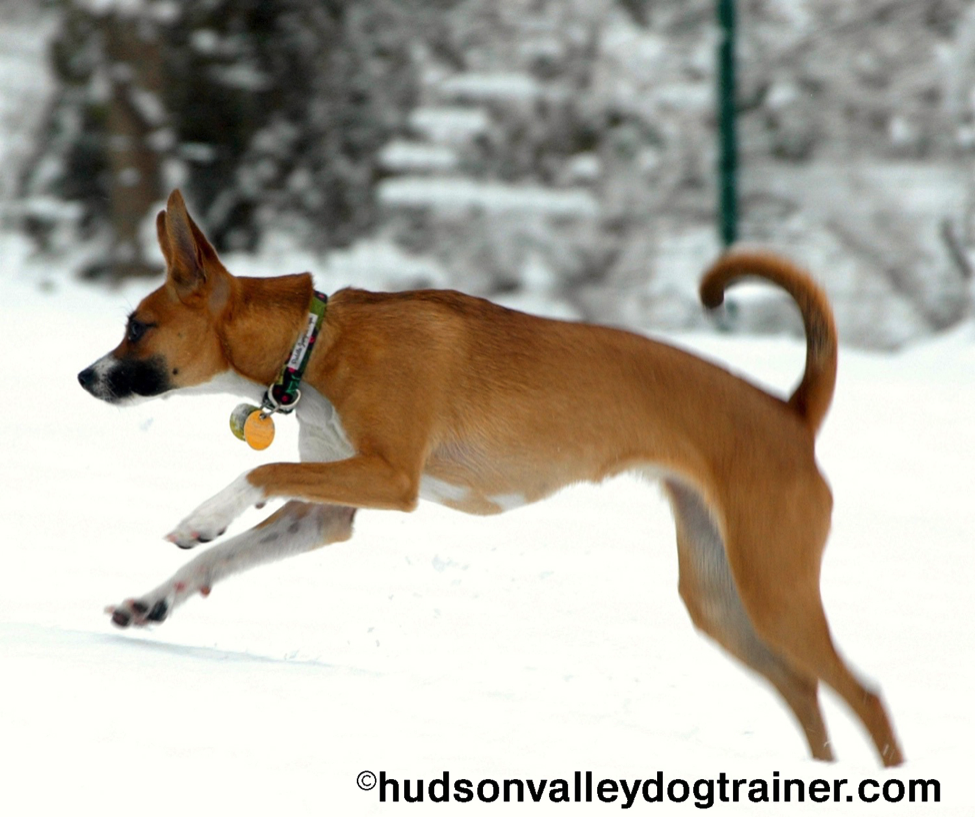
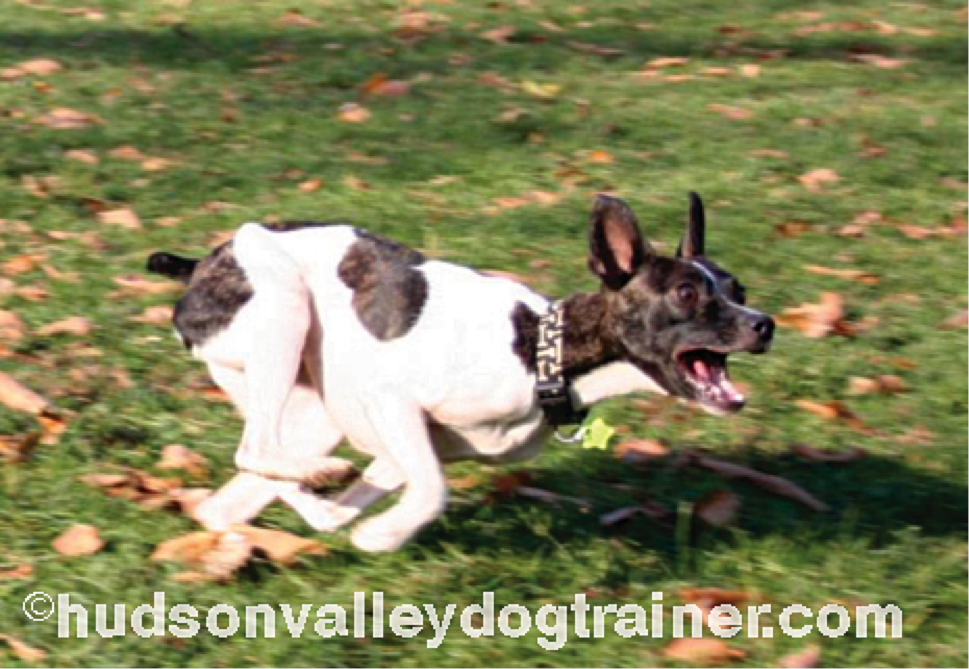
Jambo in flight, Winter 2015

Having a new puppy myself these past few months has been an eye-opening education for me (isn’t it always?) At three months, my Jambo was a wiggly, social and affectionate pup “right out of the box” – leaping into everyone’s arms for cuddles. She also ran circles around my two older dogs in the backyard and quickly learned to find her own fun in the far corners of the yard, especially when it was time to come inside. Her recalls were fantastic – as long as I didn’t have her leash in my hand. It was time for me to do some training!

I needed to put a small arsenal of training games in place that would help Jambo to race right to me, no matter what – and I really wanted to get a clue about what it was that Jambo thought was weird or scary about being leashed up, if anything. So, I started with learning about her associations with her leash and harness and doing some basic counter conditioning with the “Gotcha Collar!” game.


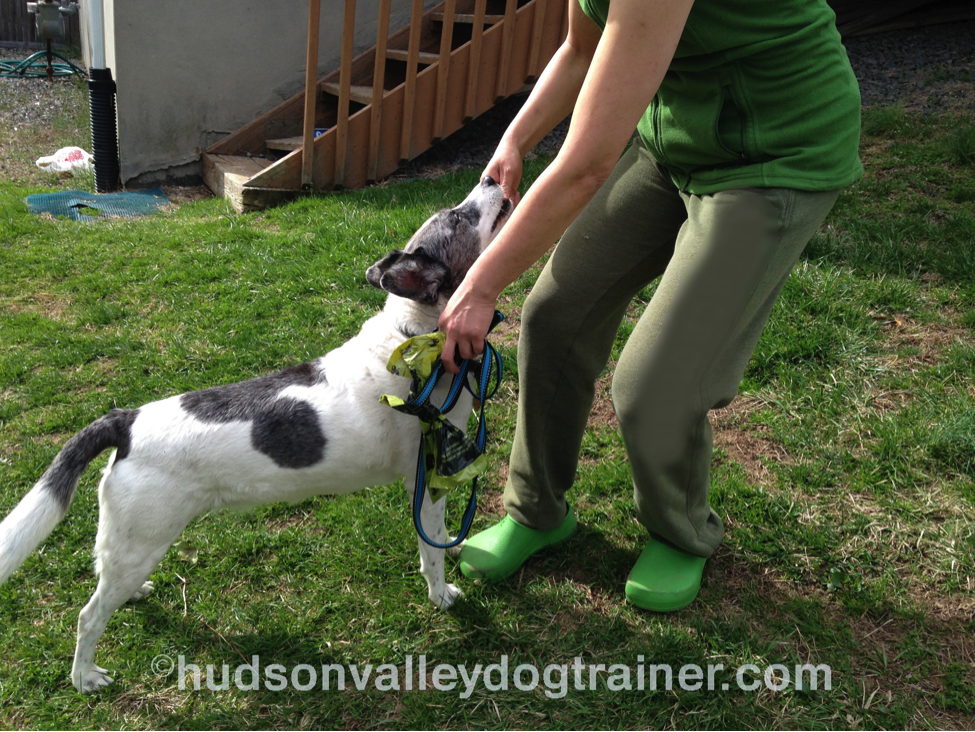
picture2.png
Gotcha Collar! plus a scrumptious treat teaches dogs to associate a collar grab with great rewards!

It’s essential to teach every young pup that human handling means Very Good Things for Dogs. In class, I ask my students to name situations in which their dogs must be handled – and the list is always longer than they think. The neighbor who narrowly captures your dog dashing out a door, or into the street; a regular vet visit that involves drawing blood and/or a nail trim; that bath you’ve been meaning to give your dog . . . In each of these examples, we want our dogs to be easy to handle and comfortable about the whole process! In my puppy classes, I introduce “Gotcha Collar!” by having the students condition handling by feeding their pups as they handle collars, ears, toes, and tails. We move on to low-key Vet Tech hugs and fun, fun restrained Recalls – and the pups and students learn a great foundation for a lifetime of low-stress handling.

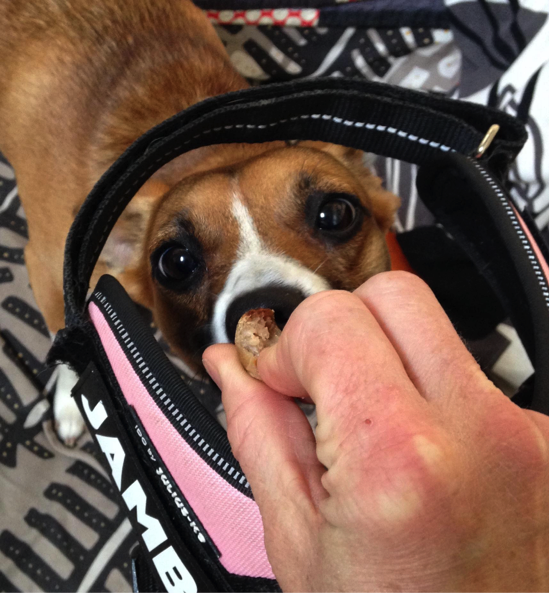
Step 1: Stick your head through your harness, get a reward.

picture3.png
I wait for Jambo to stick her head through her harness before presenting the reward.

Jambo definitely enjoyed our morning walks and learning leash-walking skills with me. However, each time I picked up her harness and leash to get ready to go out the door, she began hiding under the table! Though our good start of playing the Gotcha Collar! game had become a reliable predictor of treats and fun for Jambo, I wasn’t done with this stage of the process. The next step of Gotcha for us became “Ease of handling while putting on a harness, or coat, or ThunderShirt, or sweater.” I had neglected this follow-up step.
The best help I’ve found for this stage of the process is Jean Donaldson’s Conditioning an Emotional Response video. Jean’s guidance in this video has helped so many people teach their dogs to look forward to the appearance of a harness. I followed Jean Donaldson’s lead and used the same procedures with Jambo and her harness and got great results! If there was any question in my little dog’s mind regarding her harness (and being put into it), that went away. An ideal response here would be that your dog perks up and approaches you when the harness (or muzzle, or T-shirt etc) comes out and that your dog will voluntarily stick her head through the opening too. Remember : it is always the dog’s choice. Forcing the issue will nearly always move your progress back several steps!

To Begin:

    1. Play the Gotcha collar! game as a first step. If your dog has been fearful or cautious about scenarios involving human hands descending down upon him from on high, this first stage is the time to remedy that. Choose an environment in which your dog will be successful, and don’t stint on the treats!
    2. “Oh goody, my harness!” – as per Jean Donaldson’s video, we’re taking this one step at a time. Is your dog happily predicting the start of good stuff when her harness appears? Next, is your dog staying with you, poking her head through the harness for a “Yes!” and treat? What about the harness buckle – when you reach around to clip it, do you still have a happy dog?
    3. Present the same training questions in different places. If all goes well, play these “Oh goody, my harness!” games in locations where you’ve had a challenge. For me, this is right in front of the gate that leads to my back yard. Jambo was avoiding interactions with me there as I would always leash her up and end the fun in that spot! Instead, it’s far more productive to build a history of positive interactions with your dog in a specific place.


Back to the concept of reliable predictors for a moment. Our dogs are invested in keeping the good stuff going and will perform behaviors to that end. I used the Recall games that I taught Jambo to show her the value of coming when I call her. In hindsight, it was easy to teach her to come away from playing with a doggie friend for a great reward from me – I was able to arrange these training sessions with a little help from a friend so that she was very likely to be successful repeatedly. Thus, those games and hearing her name called were a reliable predictor for great rewards! However, I had not paid close attention to my pup’s associations with me holding her leash and harness while calling her, and as a result I spent many long minutes this winter waiting for her to come to me.


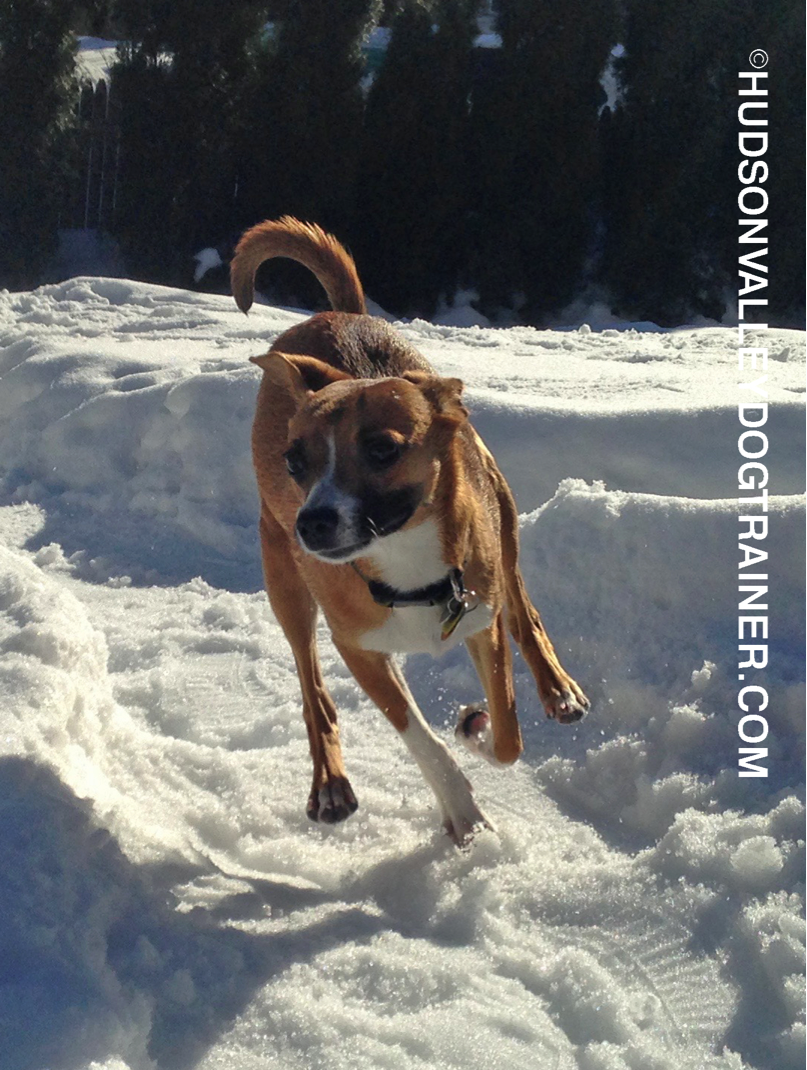
picture6.png
“Jambo, here!” I’ve had fun building value for my dogs’ recalls.

    1. Practice your Recall or “Come when Called” behavior. Ideally, Recall practice with your dog focuses on how much fun it is for your dog to chase you (not the other way around!)
    2. It’s a mistake to encourage avoidance behaviors by chasing after your dog. Trust me, your dog will always be faster – also, nobody likes to be cornered.
    3. Practice good habits that maintain what you train, even when you think you aren’t training. Avoid calling your dog’s name to scold them or to express your frustration with him; avoid calling dogs to you in order to scold or punish them. Beware of building any reliable predictor of an unpleasant association for your dog.
Good times
My person + the ballie = good times!

Other strategies to try:

  • A visual cue such as a mat or other target for your dog. (The behavior of targeting is taught to animals living in zoos to get them to move from point A to point B without stress, usually with a target stick presented for the animal to touch.) If you’ve ever trained a dog to “go to your mat” then you’re aware that this becomes a very powerful behavior. Could you use your trained “Go to your mat” behavior in a problematic area to change your dog’s association?
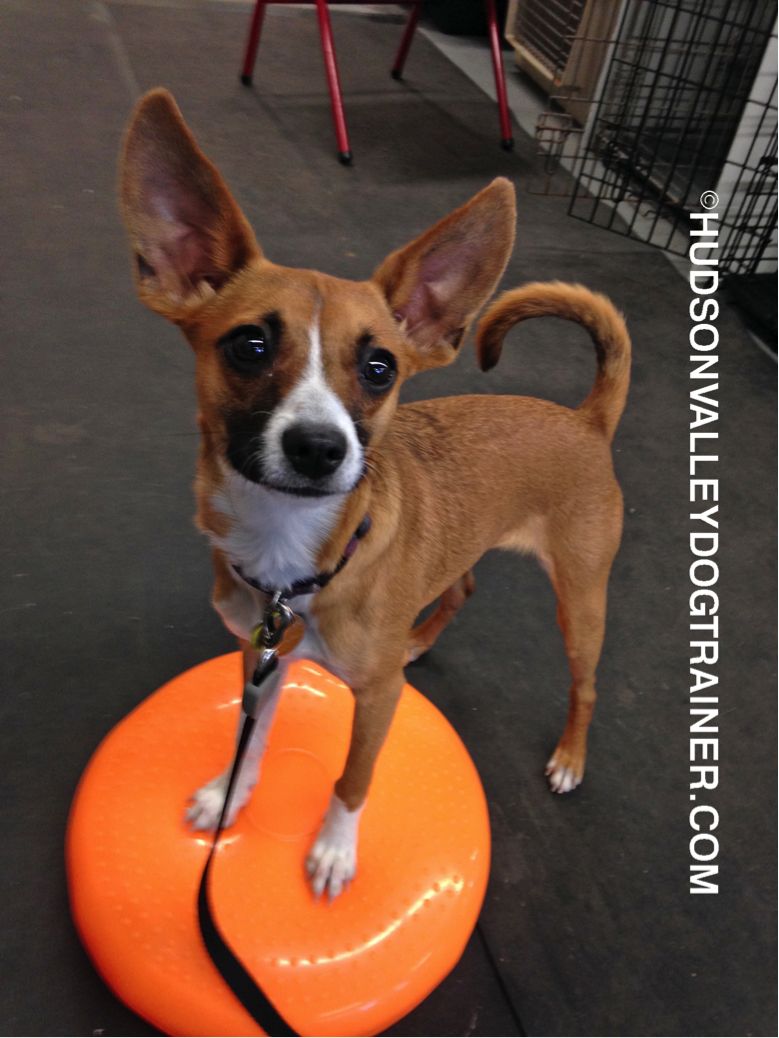
  • Another form of Targeting behavior: 2 Paws On The FitDisc, pictured below. Taught the same way as “Go to your mat”, just with more variations (2 paws on, back paws on, etc.) The bottom line : it’s a targeting behavior that you’re generally near while the dog is doing it.
Two paws on a disc

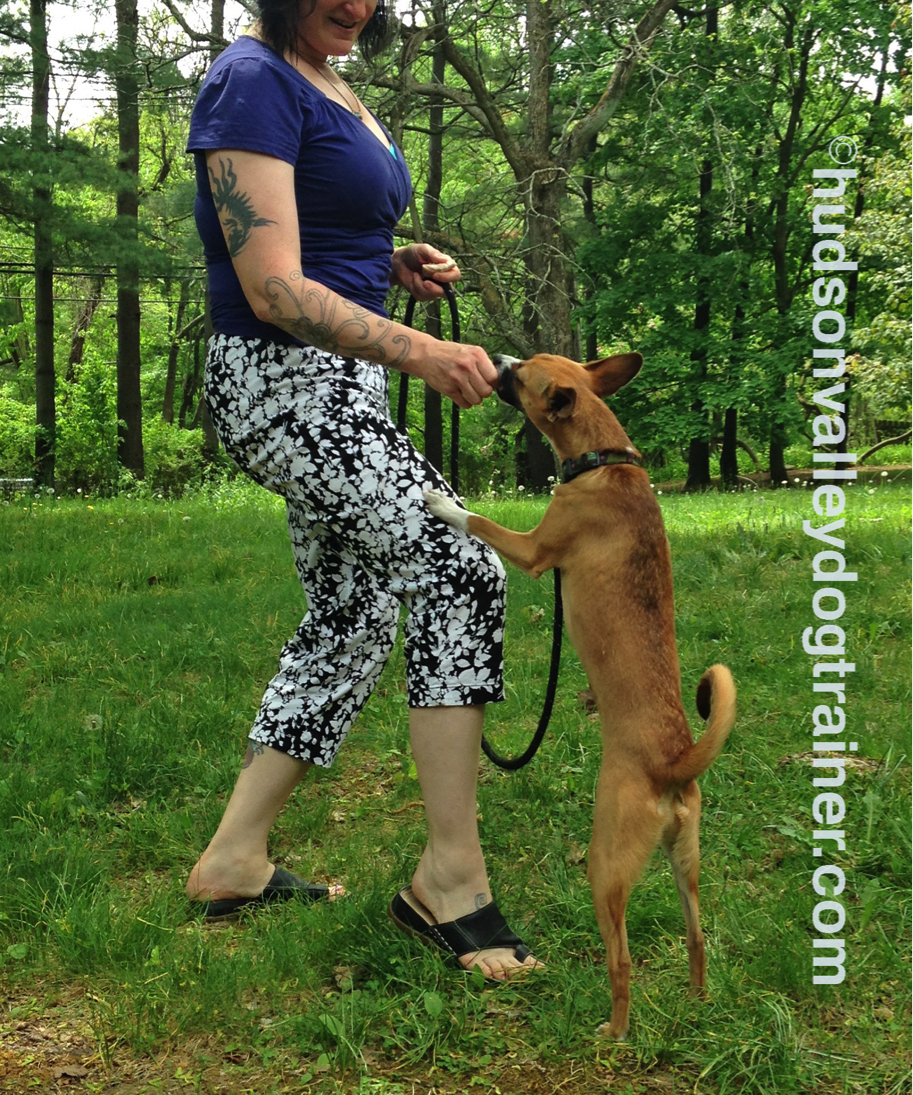
  • I have taught Jambo a trick that underscores the concept of “Lots of reinforcement for coming within grabbable range!” – she will place her 2 front paws on my knee when I give her the cue to do so. (“Jambo, hop up!”) This is a behavior that’s appropriate for a Chihuahua mix, but not so much for a larger dog.


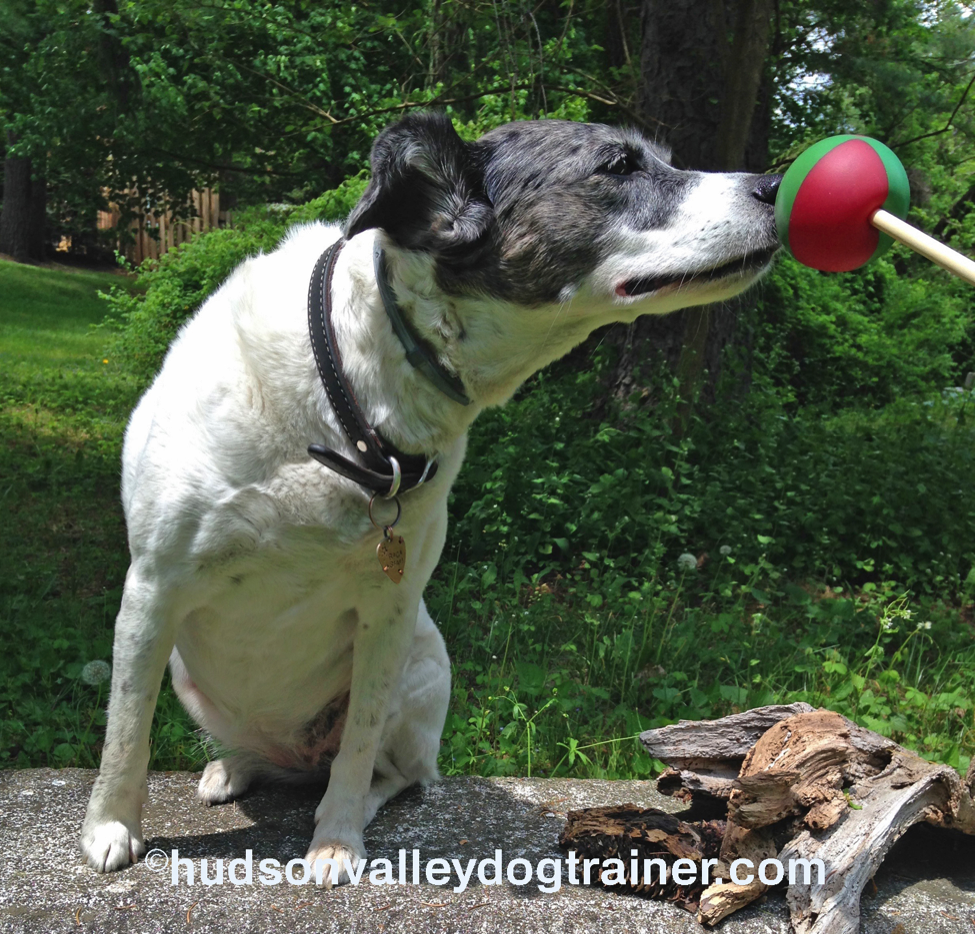
For those of you who do not wish to encourage jumping up, teach a hand target behavior. For this behavior, Jambo targets (touches) my hand with her nose and gets a reward. You may substitute an object, such as a chip clip or ball on a stick.


Another example of a targeting behavior.

  • Premack it. Of all the training strategies that I’ve mentioned in this article, the Premack Principle has been the most rewarding change-maker for me and my dogs. I will purposely set up a training situation to show my dog: to get what you want, you must first do what I want.

The Premack Principle

Jambo’s greatest reward is to be allowed to go say HI! to a person; in order to get that reward, she now needs to touch her nose to my hand, an easy behavior that Jambo was proficient with before we began this new twist on training. The Premack Principle shows us that a behavior of lower value to Jambo (the nose touch) is reinforced by a very high value reward (“Go Say HI!!!”) I myself am not above exploiting the science of behavior to get what I want. Here’s the setup : My dog is on a leash and I can tell the person assisting me to “be boring” for a sec so that Jambo is able to perform a hand target. The reward? An explosive RUN over to the person and a chance to greet. Yes, Jambo was not always immediately successful. Backing up a few steps from the distraction and asking again for a nose touch solved this. This was our warm-up; to continue, Jambo and I needed to apply the Premack Principle to the activity of being leashed up. Once again my very good-natured friends (and students!) were roped into helping us out. Harness on = more fabulous meet and greets.


I hope that this article helps you in planning strategies that you and your dog enjoy. Don’t forget clicker trainer Melissa Alexander’s wise words: “Don’t get so focused on the result that you forget to enjoy the journey.” I’ve enjoyed learning more about my new dog as she and I work through this issue.

Next time, we’ll hear from several positive trainers as I ask them the question : “What’s a training tip you’ve been sharing lately?”

Good boy, Auggie!


About the author
Misa Martin is a Certified Professional Dog Trainer. Years of attending agility seminars, workshops, seminars and camps with her first dog led to the beginning of her professional dog training career as a PetSmart Trainer in 2008. In addition to joining Port Chester Obedience Training Club’s Family Manners program, Misa is a staff trainer at the Mount Vernon Humane Society, active with Pets Alive Westchester as a group class instructor and consultant for training and behavior issues, and a volunteer for the Walden Humane Society’s education program. Misa owns Hudson Valley Dog Trainer, providing reward-based training to private clients. Through her knowledge, experience, and sense of humor, Misa encourages students to approach dog training as a team effort, where students learn as much from their dogs as dogs learn from their “parents,” making training fun for humans and dogs alike!
Misa can be reached at [email protected]